Home > Resource Center

Resource Center


  • Bag Closure Types

    Bag Closure Types: Complete Guide

    Choose the right closure for your packaging needs. Whether you need repeated access with reclosable zippers, quick sealing with lip and tape, or secure drawstring closures, Prism Pak offers FDA compliant bag closures at wholesale prices with fast shipping.

    Key benefits: Food-safe materials • Wholesale bulk pricing • Same-day shipping • Free delivery on orders $300+

    Open End Twist Tie Closure

    The common open end poly bag can be closed with twist ties or heat sealed when filled. Twist ties allow the bag to be opened repeatedly with attention to re-tying the twist. Commonly used with bread and pastry bags.

    Seal Top Reclosable

    This common and popular zip-type closure where tracks in the opening of the bag are finger-pressed together for a secure closure. These closures allow for constant opening and closing for repeated access to the contents. These closures can be found in our zip top poly bags as well as stand up pouches. Commonly used in general transport and storage of food items.

    Slide Seal Reclosable or Zipper Seal

    This is another common and popular closure where tracks in the opening of the bag are pressed together by a slider mechanism attached to the bag opening for a secure closure. These closures allow for constant opening and closing for repeated access to the contents and they are especially easy to use with gloved hands. Commonly used in general transport and storage of food items.

    Lip and Tape Adhesive Closure

    Lip and Adhesive Tape Closure is another way bags are closed. The extended lip of one side of the bag has an adhesive tape that when folded over on the other side of the bag, effectively closes the bag. Commonly used in polypropylene sandwich and snack bags.

    Lip and Flip Closure

    An extended lip with a reverse pocket allows the bag to be held by the lip and flipped backwards and pulled down to effect the closing of the bag in one operation. Fast and convenient. Commonly used in poly sandwich bags.

    Drawstring Closure

    Drawstring closure bags allow easy access and also repeated access if needed. Drawstring closures are commonly used for ice bags.

  • Cello Bag Types

    Real Cello Bags vs Fake: Know the Difference

    Many retailers sell "cello bags" made from cheap Cast Polypropylene (CPP)—but these lack the strength, clarity, and food-safe barrier protection of true cellophane bags. Prism Pak sells only genuine BOPP and Cellophane cello bags, trusted by bakeries, food manufacturers, and craft businesses for superior product protection.

    Why it matters: Real BOPP bags keep food fresher longer, resist punctures, and meet FDA food-safe standards. Cheap CPP bags stretch, tear easily, and compromise product quality.

    👇 Scroll down to learn the 5-point test for identifying real cello bags

  • Choosing Bag Thickness

    Plastic Bag Thickness Guide: Choosing the Right Mil

    Quick Answer: A mil is one-thousandth of an inch (0.001"). It measures plastic bag thickness. Higher mil = thicker, stronger bags. Most applications use 1.5-2 mil bags, while heavy-duty needs require 3-6 mil.

    Choosing the right bag thickness is just as important as selecting the correct dimensions. The wrong thickness wastes money (too thick) or risks product damage (too thin). This guide explains mil ratings and helps you pick the perfect thickness for your application.

    What Does Mil Mean in Plastic Bags?

    Bag thickness is measured with a micrometer (pictured below). One mil equals 1/1000 of an inch, or 0.001". To put this in perspective:

    Micrometer measuring bag thickness

    • A human hair: ~2-3 mil thick
    • Grocery store bag: 0.5 mil
    • Dry cleaning bag: 0.75 mil
    • Bread bag: 1.5 mil
    • Freezer bag: 1.75 mil
    • Retail shopping bag: 2 mil

    Note: Mil is not millimeter. 1 mil = 0.0254 mm.

    How to Choose the Right Bag Thickness

    Before selecting a mil rating, consider these factors:

    1. Product Weight and Size

    Heavy items need thicker bags. A 10-pound metal part requires 4+ mil protection, while lightweight apparel works fine at 1.5 mil.

    2. Sharp Edges or Abrasive Surfaces

    Hardware, tools, or items with sharp corners need 3-6 mil bags to prevent punctures.

    3. Reusability

    Single-use bags can be 1-1.5 mil. Reusable bags should be at least 2 mil for durability.

    4. Clarity vs. Strength Trade-off

    Thicker bags are less transparent. If product visibility matters, use the thinnest mil that still provides adequate protection.

  • Commonly Used Terms

    Plastic Bag & Packaging Terminology Guide – Your quick reference for understanding bag specifications, material properties, and industry terms. Whether you're ordering poly mailers, food packaging, or custom bags, this glossary helps you speak the language of flexible packaging.

    Browse common terms used in bag sizing, film types, closure methods, and manufacturing specifications. Need help finding the right product? Use these definitions to match your requirements to our product categories.

  • LK Packaging Catalogs

    LK Packaging Catalogs

    Prism Pak is an authorized distributor of LK Packaging (Elkay Plastics), one of North America's leading manufacturers of flexible packaging. We stock the full line of LK Packaging products including food service bags, grocery bags, industrial liners, healthcare packaging, and more—all available for immediate shipment.

    Why Buy LK Packaging from Prism Pak?

    • Wholesale Pricing: Volume discounts on all LK Packaging products
    • Fast Shipping: Same-day shipping on in-stock items
    • Authorized Distributor: Genuine LK Packaging products with full manufacturer warranty
    • Expert Support: Need help finding the right product? Contact us for product recommendations

    Browse LK Packaging Product Catalogs

    Click any catalog below to view the complete product line:

    LK Packaging Food Service Catalog LK Packaging Grocery Catalog LK Packaging Industrial Catalog LK Packaging Healthcare Catalog

  • Measuring Tips

    How to Measure Poly Bags: Complete Sizing Guide

    Getting the right bag size matters. Too small and your product won't fit. Too large and you're wasting money on excess material. This guide shows you exactly how to measure flat bags, gusseted bags, and reclosable poly bags so you order the perfect size every time.

    Quick Reference: All poly bag measurements are inside diameter (ID). Width is always listed first, followed by length, then gauge (thickness). Measurements are in inches.

    • Width = Opening across the top of the bag
    • Length = Usable depth from top to bottom
    • Gauge = Film thickness (not needed for sizing, but important for strength)

    Need help finding the right bag? Contact us with your product dimensions and we'll recommend the perfect size.


    Bag Type Order of Measurement

    Flat Bags: Width x Length x Gauge
    Side Gusset Bags: Width x Gusset x Length x Gauge
    Bottom Gusset Bags: Width x Length x Gusset x Gauge
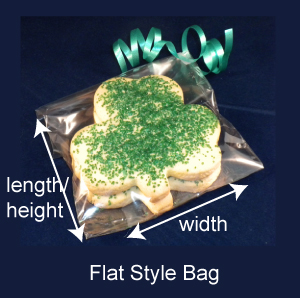


    Measuring Cello Bags FlatMeasuring for Flat Bag: Width x Length

    Width = Opening of bag (across the top of the bag)
    Length
    = Usable portion of bag (from top to bottom of the bag)
    Gauge
    = Film thickness, measured in mils or microns

    Example
    Width
    = 8 inches
    Length
    = 5 inches
    Gauge = .002 inches

    Bag size is written as: 8" x 5" 2 mil
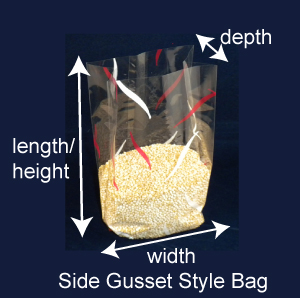


    Measuring Cello Bags SquareMeasuring for Side Gusseted Bags: Width x Gusset x Length

    Width = Across opening of the bag (with gusset tucked in)
    Gusset
    = Depth or Distance across the open face of side pleat
    Length
    = From the opening to the bottom of the bag
    Gauge
    = Thickness of bag, measured in mils.

    Example:
    Width
    = 8 inches
    Gusset
    = 5 inches
    Length
    = 10 inches
    Gauge
    = .002 inches

    Bag size is written as: 8"x 5" x 10" 2 mil
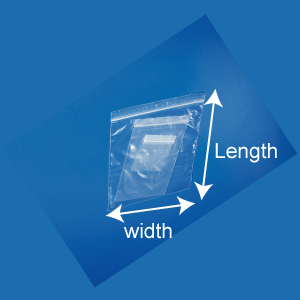


    Measuring Reclosable Bags ImageMeasuring for a Reclosable Poly Bag: Width x Length x Gauge

    Bags are measured width by length. Width is the outside dimension. Depth is measured from the bottom of the zipper to the bottom of the bag. Due to reinforced side seals, bag openings are approximately 1/2" less than their listed width.

    Width = Across opening of the bag (with gusset tucked in)
    Length = From the opening to the bottom of the bag
    Gauge
    = Thickness of bag, measured in mils.

    Example:
    Width
    = 8 inches
    Length = 10 inches
    Gauge
    = .002 inches

    Bag size is written as: 8" x 10" 2 mil


    Measuring a round object? Click here.


  • Printing Options

    Custom Printing Options for Packaging

    Choose the right printing method for your packaging needs. We offer flexographic printing (flexo), gravure printing, and sheet-fed offset printing for bags, films, and flexible packaging. Each method delivers different quality levels, costs, and capabilities.

    Quick Comparison

    • Flexographic (Flexo): Best for moderate runs, up to 6 colors, 65-133 line screen resolution. Fast, cost-effective for bags and film.
    • Gravure: High-volume production, up to 7 colors, 150-175 line screen. Excellent for metallics and fine detail on coated papers.
    • Offset: Premium quality, unlimited colors, 150-175 line screen. Ideal for small runs requiring photographic reproduction.

    Need help choosing? Contact us at 570-709-0366 or [email protected] with your artwork and quantity—we'll recommend the best method for your project.

  • Shipping Info

    Fast, Reliable Shipping Nationwide

    Orders ship within 24 hours during business days (Mon-Fri, 8AM-5PM EST). Choose from UPS Ground, 2-Day Air, 3-Day Select, or Next Day Air at checkout. All orders include tracking.

    Need it fast? Contact us at [email protected] or 1-800-569-1266 before 12pm EST for same-day processing.

  • Packaging Guides

    Packaging Guides & Buyer Resources

    Choosing the right packaging shouldn't require a degree in materials science. Our guides cut through the jargon and help you make informed decisions — whether you're selecting poly bags for e-commerce shipping, choosing food-safe packaging for your bakery, or comparing wholesale suppliers for your growing business.

    What makes these guides different? We include our competitors. We explain what we don't sell and who does it better. Because the best supplier for your needs might not always be us — and we'd rather you make the right choice than the easy one.

    What You'll Find Here

    • Supplier Comparisons — Objective reviews of wholesale packaging suppliers (including Uline, noissue, and ourselves). Pricing structures, minimum orders, shipping times, and who's best for different business types.
    • Material & Sizing Guides — Technical guides on bag materials (LDPE vs HDPE, mil thickness ratings), sizing charts by product type, and when to choose poly vs cello vs BOPP.
    • Industry-Specific Resources — Packaging guidance for food service, e-commerce, retail, and manufacturing. FDA compliance, food-safe materials, and application-specific recommendations.
  • FAQs

    Frequently Asked Questions

    Got questions about packaging? We've got answers. From poly mailer sizing to shipping best practices, find everything you need to know about choosing the right packaging for your business.

    Quick answers to: Material types • Sizing guides • Shipping methods • Wholesale pricing • Custom printing • FDA compliance

  • Sustainability

    Sustainable Packaging Solutions

    Looking for environmentally responsible packaging? Prism Pak's recyclable plastic bags offer a surprisingly eco-friendly alternative. Our data-driven approach to sustainability shows plastic bags use 40% less energy and 96% less water to produce than paper bags.

    Why choose our sustainable poly bags:

    • ✓ 100% recyclable HDPE and LDPE materials
    • ✓ Manufactured using renewable wind energy
    • ✓ Recycled content options available
    • ✓ FDA-approved food-safe materials
    • ✓ Wholesale pricing on bulk orders
    Environmental FactorPlastic BagsPaper Bags
    Energy to Produce40% less than paper40% more than plastic
    Water to Produce96% less water needed96% more water required
    Landfill Weight2000 bags = 30 lbs2000 bags = 280 lbs
    Greenhouse Gas Emissions50% less than paper50% more than plastic
    Recycling Energy91% less energy per lb91% more energy needed
    Air Pollutants70% less than paper70% more than plastic
    Water Pollution50x less than paper50x more than plastic